
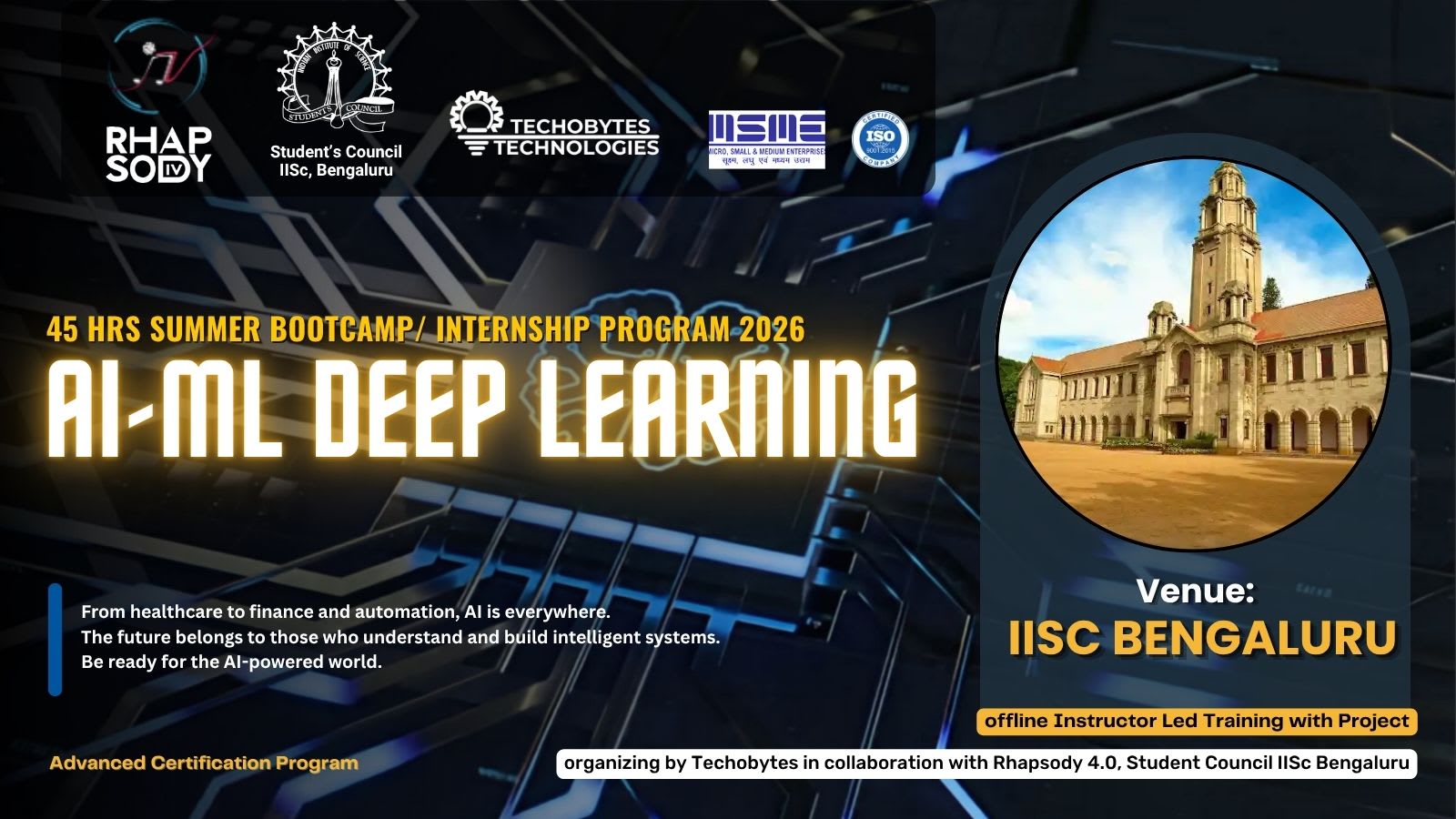
AI-ML-Deep Learning - 45 HRS Summer Training Program'26 at IISc Bengaluru
About
About the Event
45-HOUR SUMMER BOOTCAMP/INTERNSHIP PROGRAM 2026 WITH PROJECT AT IISc BENGALURU BY TECHOBYTES IN COLLABORATION WITH RHAPSODY 4.0, STUDENT COUNCIL IISC BENGALURU
About Techobytes
Techobytes Technologies is recognised as a leading expert in the design and delivery of technical, soft and hard skills training from individual courses and seminars to certification programs and full-scale training solutions, from classroom training to online training.
Duration: The event is scheduled for 5 consecutive days, from 10th June 2026 to 14th June 2026.
The training will include 40 hours of intensive learning with a project, covering concepts from basic to advanced level.
Note: Candidates opting for the offline course at IISc Bengaluru, will also receive access to one complimentary 40 HRS online course of their choice.
Benefits and certification:
- 40-45 hours certification/internship program.
- 3 certificates in each training. (Participation Certificate + 1 Bootcamp/ Internship Certificate with + Project Completion Certificate)
- Updated industry-equipped curriculum.
- Work on live projects.
- Hands-on training by certified trainers from the industry.
- Complimentary resume and CV building session.
- Get an opportunity to attend a technical workshop from Techobytes in IIT’s.
Artificial Intelligence, Machine Learning & Deep Learning
Course Duration: 45 Hours
Level: Beginner to Advanced
Target Audience: Open to ALL, B.tech, B.E, B.sc IT, M.sc It, IT Sector, Programmers, Undergraduate students, early researchers, or professionals entering into AI.
Prerequisite Software: Anaconda, Antigravity IDE
Foundations of Artificial Intelligence & Machine Learning
Objective: Build a strong fundamental understanding of AI, its subfields, and how it differs from traditional programming.
Module 1: Demystifying Artificial Intelligence
● What is AI? History, evolution, and current applications defining the modern era
● Traditional Programming v s. AI Programming:
○ Traditional: Rules + Data = Answers
○ AI: Answers + Data = Rules
● The AI Landscape: Clear distinctions and intersections between Artificial Intelligence (AI), Machine Learning (ML), and Deep Learning (DL).
Module 2: Core Concepts of Machine Learning
● Types of Learning:
○ Supervised Learning (Classification & Regression)
○ Unsupervised Learning (Clustering & Dimensionality Reduction)
○ Reinforcement Learning (Reward-based learning)
Vocabulary in AI: Must-know terminology (Features, Labels, Training/Testing Splits, Epochs, Overfitting/Underfitting, Bias-Variance Tradeoff).
Module 3: Hands-On Machine Learning - Project 1
● Environment Setup: Introduction to Python, Pandas, Scikit-Learn (via Anaconda), and the Antigravity IDE.
● Project 1 (Supervised Learning): Building a predictive model (e.g., Predicting Housing Prices using Linear Regression or Iris Flower Classification)
● Activities: Data preprocessing, model training, and evaluating accuracy.
Module 4: Hands-On Machine Learning - Project 2
● Project 2 (Unsupervised Learning / Advanced Supervised): Customer Segmentation using K-Means Clustering OR predicting churn using Decision Trees/Random Forests.
● Activities: Feature engineering, model tuning, and visualizing results. ➡
Introduction to Deep Learning & Neural Networks
Objective: Transition from traditional ML to Deep Learning, understanding the biological inspiration and mathematical engines behind neural networks.
Module 1: The Building Blocks of Deep Learning
● What is a Neuron? Biological inspiration vs. Artificial Neurons (Perceptrons).
● Weights, Biases, and Activation Functions: (Sigmoid, ReLU, Tanh, Softmax) - How
networks make non-linear decisions.
Module 2: Network Architecture & Training Mechanics
● What is a Neural Network? Input layers, hidden layers, and output layers. Forward propagation.
● How Networks Learn: Loss Functions (measuring error) and Optimizers (Gradient Descent, Adam).
● What is the Backpropagation Algorithm? The chronological chain rule of calculus that allows networks to update weights and "learn" from mistakes.
Module 3: Fully Connected Neural Networks (FC NN)
● Deep Dive into FC NN: Architecture, limitations, and use-cases for Dense networks.
● Introduction to Frameworks: Getting started with TensorFlow/Keras or PyTorch.
Module 4: Hands-On Fully Connected Neural Network
● Project 3: Building a Fully Connected Neural Network from scratch.
● Activities: Building a model to predict complex tabular data (e.g., Diabetes prediction
or basic image classification using dense layers).
Computer Vision & Convolutional Neural Networks (CNNs)
Objective: Master how AI "sees" the world by understanding and building Convolutional Neural Networks.
Module 1: Introduction to Computer Vision & CNNs
● What is CNN? Why Fully Connected Networks fail at images.
● CNN Operations: Convolutions, Kernels/Filters, Stride, and Padding.
● Pooling Layers: Max Pooling vs. Average Pooling for spatial reduction.
Module 2: Advanced CNN Architectures
● Feature extraction vs. Classification heads.
● Overview of famous CNN architectures (ResNet, VGG).
● Concept of Transfer Learning (leveraging pre-trained models).
Module 3: Hands-On CNN - Part 1 Project 4: Image Classification with CNNs.
Activities: Importing an image dataset (e.g., CIFAR-10 or MNIST), building a custom CNN architecture.
Module 4: Hands-On CNN - Part 2
Activities: Training the CNN, evaluating performance, visualizing feature maps, and
deploying techniques like Data Augmentation to prevent overfitting.
Sequence Models & Introduction to Generative AI
Objective: Learn how AI processes sequential data (like text/time) and step into the world of Generative modeling.
Module 1: Sequence Data & Recurrent Neural Networks (RNNs)
What is an RNN? Handling sequential data (Time-series, text, audio).
The concept of "Memory" in AI: Hidden states and sequence processing. Challenges: The vanishing gradient problem (Brief intro to modern solutions like
LSTMs/GRUs).
Module 2: Hands-On RNN
Project 5: Natural Language Processing (NLP) / Sequence Analysis.
Activities: Building an RNN for Sentiment Analysis (e.g., IMDB movie reviews) or a basic text-generation model.
Module 3: Introduction to Generative AI
● What is Generative AI? Discriminative Models (Predicting labels) vs. Generative Models (Creating new data).
● The spectrum of Generative AI (Text, Images, Audio).
● What are Autoencoders? Architecture (Encoder, Bottleneck/Latent Space, Decoder).
Module 4: Hands-On Autoencoders
● Project 6: Building a basic Autoencoder.
● Activities: Implementation for image compression or image denoising (cleaning noisy images via bottleneck reconstruction).
Advanced Generative AI Models (VAEs & GANs)
Objective: Explore the state-of-the-art architectures that power modern AI image and data generation.
Module 1: Variational Autoencoders (VAEs)
● What are Variational Autoencoders? How they differ from standard Autoencoders.
● Probabilistic Latent Spaces: Mean, variance, and the reparameterization trick.
● Generative capabilities of VAEs.
Module 2: Hands-On Variational Autoencoders
● Project 7: Generating new data with VAEs.
● Activities: Building a VAE to generate completely novel images (e.g., generating new
handwritten digits or fashion items).
Module 3: Generative Adversarial Networks (GANs)
● What is a GAN? The game-theoretic approach to AI.
● Architecture: The Generator (the counterfeiter) vs. The Discriminator (the police).
● Training dynamics, loss functions, and common challenges (Mode collapse).
Module 4: Hands-On GANs & Course Wrap-Up
● Project 8: Building a Simple GAN.
● Activities: Implementing a Deep Convolutional GAN (DCGAN) to generate realistic
images from random noise.
● Wrap-Up: Summary of the training, Q&A, and discussion on the future of AI and
ethical considerations.
Get an immersive learning experience. Sessions will be led by industry experts, offering hands-on practicals and a cutting-edge curriculum aligned with industry standards.
By attending, you'll not only gain valuable tech knowledge but also have the opportunity to network with industry professionals and connect with fellow participants, expanding both your skills and your professional circle.
Thanks and regards,
Techobytes Technologies