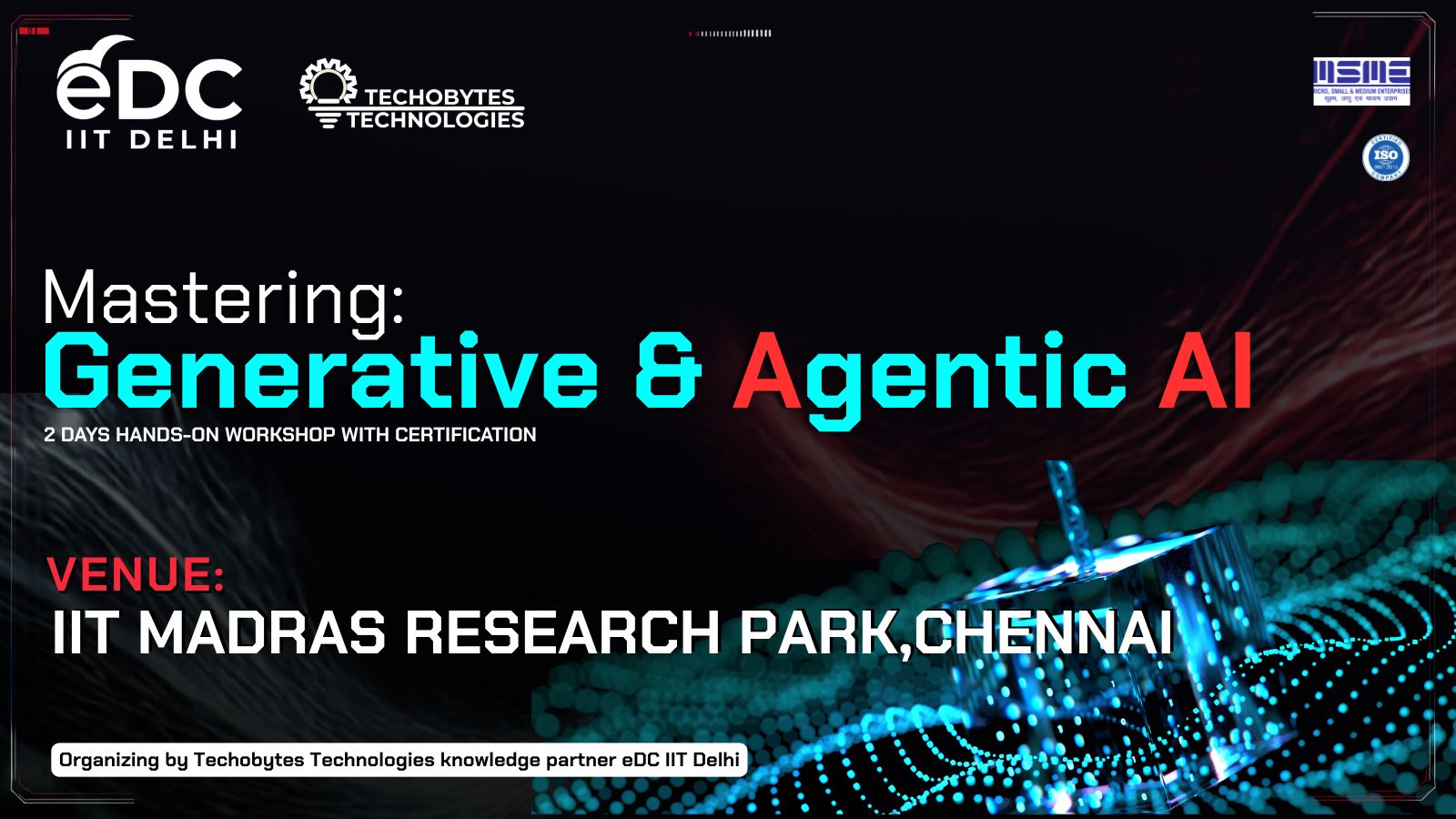
Certified Tech Workshop Series 2026 by Techobytes with knowledge partner eDC IIT Delhi.
Hands-on training, practical demonstrations, certification.
Mastering Generative and Agentic AI
(Exploring the Frontiers of Generative Models)
DAY 1 | Foundations & Application Building
1. Generative & Agentic AI Essentials
AI, ML, Deep Learning, and Generative AI; Transformer and LLM fundamentals; tokens, context windows, and hallucinations; chatbots vs. workflows vs. agents; model selection based on capability, cost, and latency.
Hands-on:
Explore engineering and workplace use cases, and compare model responses.
2. Prompt & Context Engineering
Clear instructions, few-shot examples, task decomposition, and structured outputs; supplying relevant documents and conversation context; introduction to multimodal inputs.
Hands-on:
Create prompts for technical explanations, coding assistance, and document extraction.
3. Build Your First GenAI Application
Calling an LLM through a Python API; system instructions, conversation history, and JSON output validation; API key handling and basic error management.
Hands-on:
Build a technical assistant that explains concepts and summarizes documents.
4. RAG: Chat with Your Documents
Document loading, chunking, embeddings, vector search, and retrieval; answers with source references; handling missing information; when to use prompting, RAG, or fine-tuning.
Hands-on:
Build a PDF knowledge assistant using FAISS or ChromaDB.
DAY 2 | AI Agents, Automation & Project Development
5. Build a Tool-Using AI Agent
Agent components: model, instructions, tools, and state; function calling and tool schemas; tool selection and result handling; execution limits and failure handling.
Hands-on:
Build an agent that searches documents and uses a calculator or sample API.
6. Agentic Workflows with LangGraph
State, nodes, conditional routing, and checkpoints; conversation memory and human approval; introduction to Model Context Protocol (MCP) for connecting tools and data; overview of multi-agent patterns.
Hands-on:
Create a retrieve, analyze, draft, and review workflow.
7. Evaluate & Improve AI Systems
Test questions, answer accuracy, source grounding, and tool-selection checks; prompt injection, data privacy, and tool permissions; trace inspection, token usage, cost, and latency.
Hands-on:
Test incorrect answers, missing context, and failed tool calls.
8. Capstone: Agentic Knowledge Assistant
Combine RAG, tool calling, and a review step; create a simple Streamlit interface; run locally and demonstrate a deployment path.
Hands-on:
Complete and present a working prototype for an engineering or workplace use case.
What Participants Will Build
An API-based Generative AI assistant; a document-based RAG application with source references; and a tool-using agent integrated into a practical project prototype.
WORKSHOP DETAILS
Practical skills for academic projects and workplace applications
Tools & Technologies
Python • Jupyter / Google Colab • One selected LLM API • LangChain / LangGraph • FAISS or ChromaDB • Streamlit
One primary model provider and one vector store will be used throughout the practical sessions to keep the learning focused.
Eligibility & Requirements
Suitable for B.E. / B.Tech students across engineering branches, BCA / MCA students, developers, IT professionals, and technical researchers.
Basic Python knowledge is recommended. Prior AI experience is not required.
Participants should bring a laptop. Setup instructions, starter code, and API access arrangements should be provided before the workshop.
Key Benefits
• Build practical AI applications for academic and workplace tasks.
• Connect AI with documents, tools, and APIs.
• Develop automation workflows with human review.
• Understand accuracy, privacy, cost, and performance considerations.
• Complete a project prototype for further portfolio development.