Gingee Fort, regarded as one of the strongest forts of medieval Tamil Nadu, gained prominence in the late 17th century C.E. with the rise of the Nayakas. Traditionally attributed to the 13th century C.E. chieftain Ananda Kon, it occupies a dramatic landscape shaped by steep granite hills and expansive defensive architecture.
Historical Background
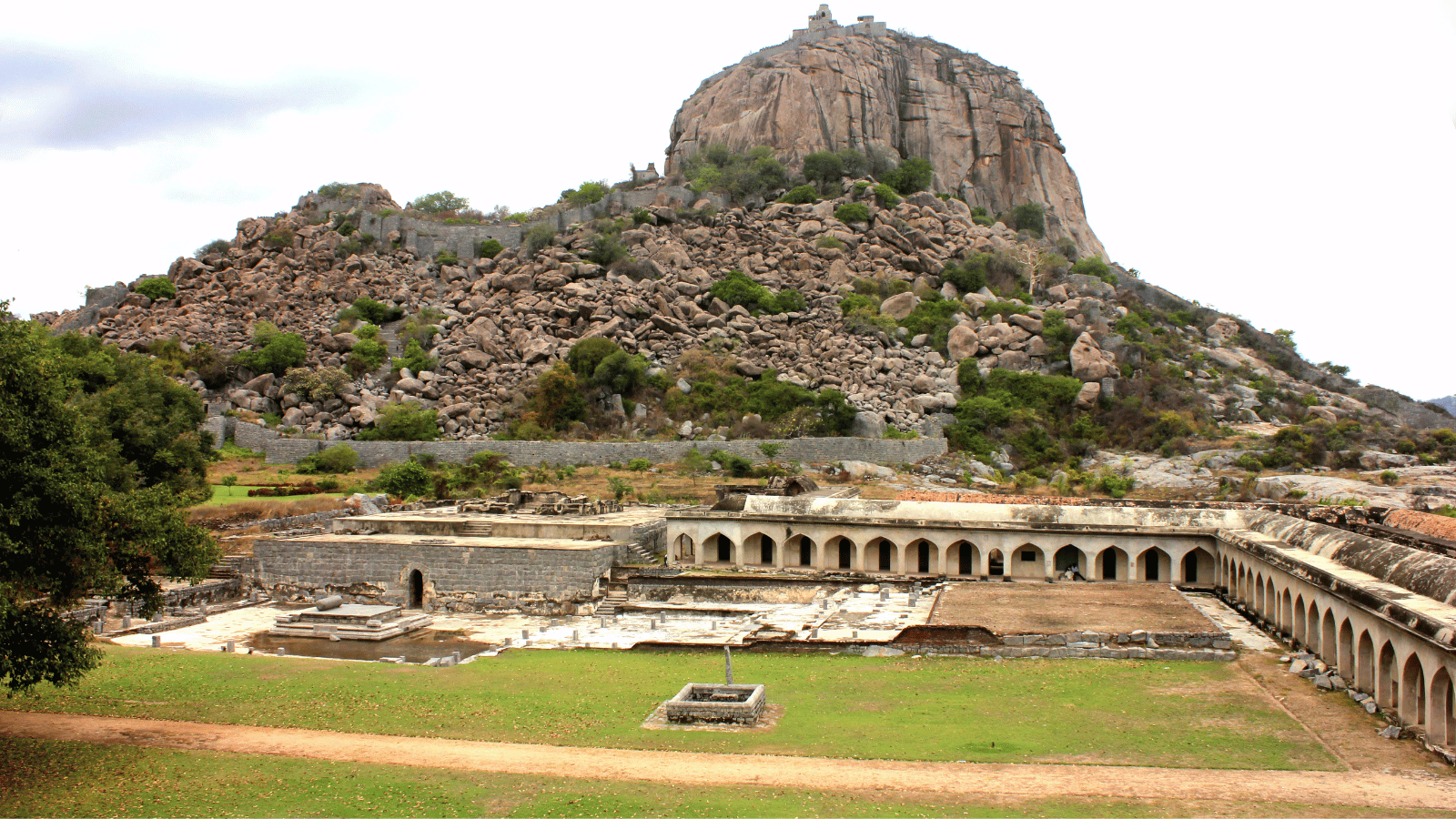
The fort evolved through several construction phases. Its lofty fortifications connect the precipitous hills of Krishnagiri, Chandragiri or Chakkilidurg, and Rajagiri, forming a triangular arrangement that strengthened its defensive capability. Ramparts and interior structures reflect the administrative and military needs of successive rulers.
Location and Significance
Located in Tamil Nadu, the fort spreads across about 11 square kilometres and contains two principal entrances known as the Pondicherry and Vellore Gates. Rajagiri, the most prominent hill, is inaccessible on three sides, with a ravine on the fourth offering a difficult ascent into the main interior zone.
Architectural Materials and Design
Within the enclosure lie barracks, guard rooms, the Kalyana Mahal, quarters for royal staff, the king’s audience hall, palace remains, and the large Elephant Tank reservoir, all positioned at the foothills. These features illustrate a well-planned fortified centre suited to both governance and defence.

 4.6•
4.6•
 Ticket needed for all ages
 Entry allowed for all ages
 Kid friendly
 Pets not allowed
 Free water stations
 Washrooms available
 Vignesh
 Jacob Joseph (Jac)
 Adwaith Shine
 Lens & Latitude
 Amit Tyagi