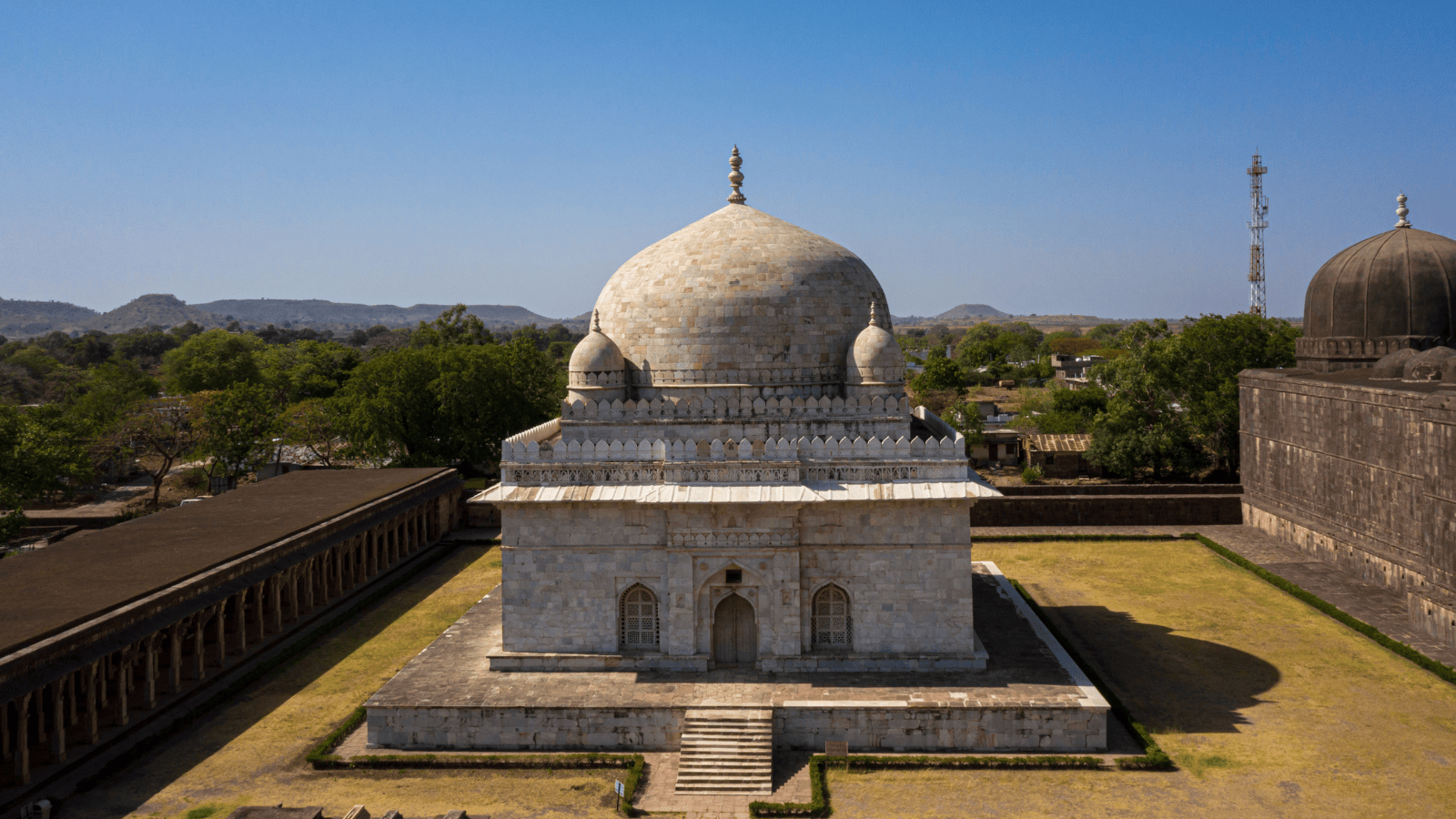
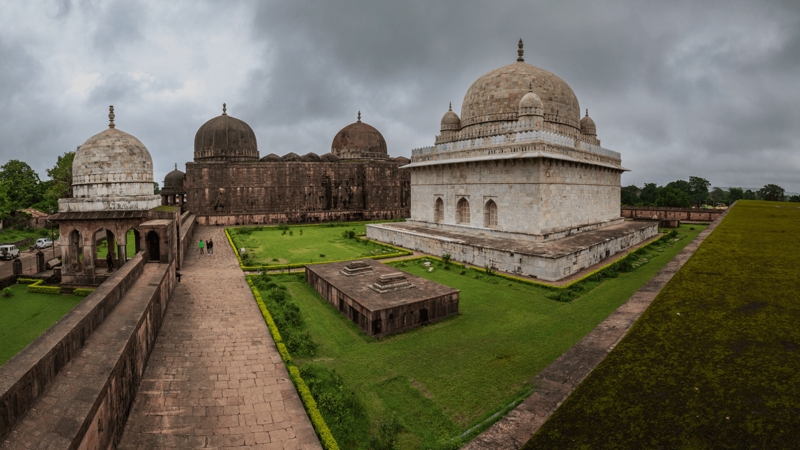
Hoshang Shah’s Tomb is a distinguished monument commemorating the ruler of the Malwa Sultanate. Constructed in white marble, it exemplifies medieval Islamic architecture, featuring proportional arched openings, a central dome, and elegant symmetry that highlight the sophistication of the era.
Historical Background
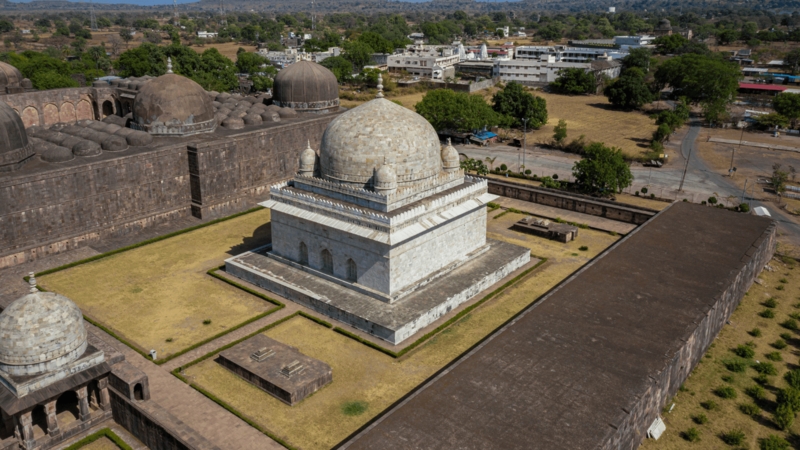
Built to honor Hoshang Shah, the tomb demonstrates the Malwa Sultanate’s refined craftsmanship and cultural legacy. The mausoleum rests on a square platform, shaped like a casket with mihrab molding, while additional graves lie beneath the dome. A stone pavement frames the main structure, reinforcing the monument’s harmonious design.
Location and Significance
The tomb is located in Mandu, Dhar district, Madhya Pradesh. It is part of a historic complex that includes Dilawar Khan’s Mosque, Hindola Mahal, Jahaz Mahal, Jami Masjid, Ashrafi Mahal, Malik Mughith’s Mosque, Baz Bahadur’s Palace, Rupmati’s Pavilion, and Darya Khan’s Tomb. Its accessibility and historical prominence make it a major destination for heritage tourism.
Architectural Materials and Design
Constructed entirely of white marble, the monument is square in plan with a central dome. Arched openings, stone pavements, and symmetrical design emphasize both aesthetic and structural mastery, reflecting classical Islamic architectural principles of the region.

 4.3•
4.3•
 Ticket needed for all ages
 Entry allowed for all ages
 Kid friendly
 Pets not allowed
 Washrooms available
 Free water stations
 Muhammed Wajeeh
 Jayeshbhoomi Vaza
 Amandeep S Cheema
 Aditya Ghosh
 Vinod Kumar Tripathi