
IoT-Robotics-ROS | 2-Day Workshop
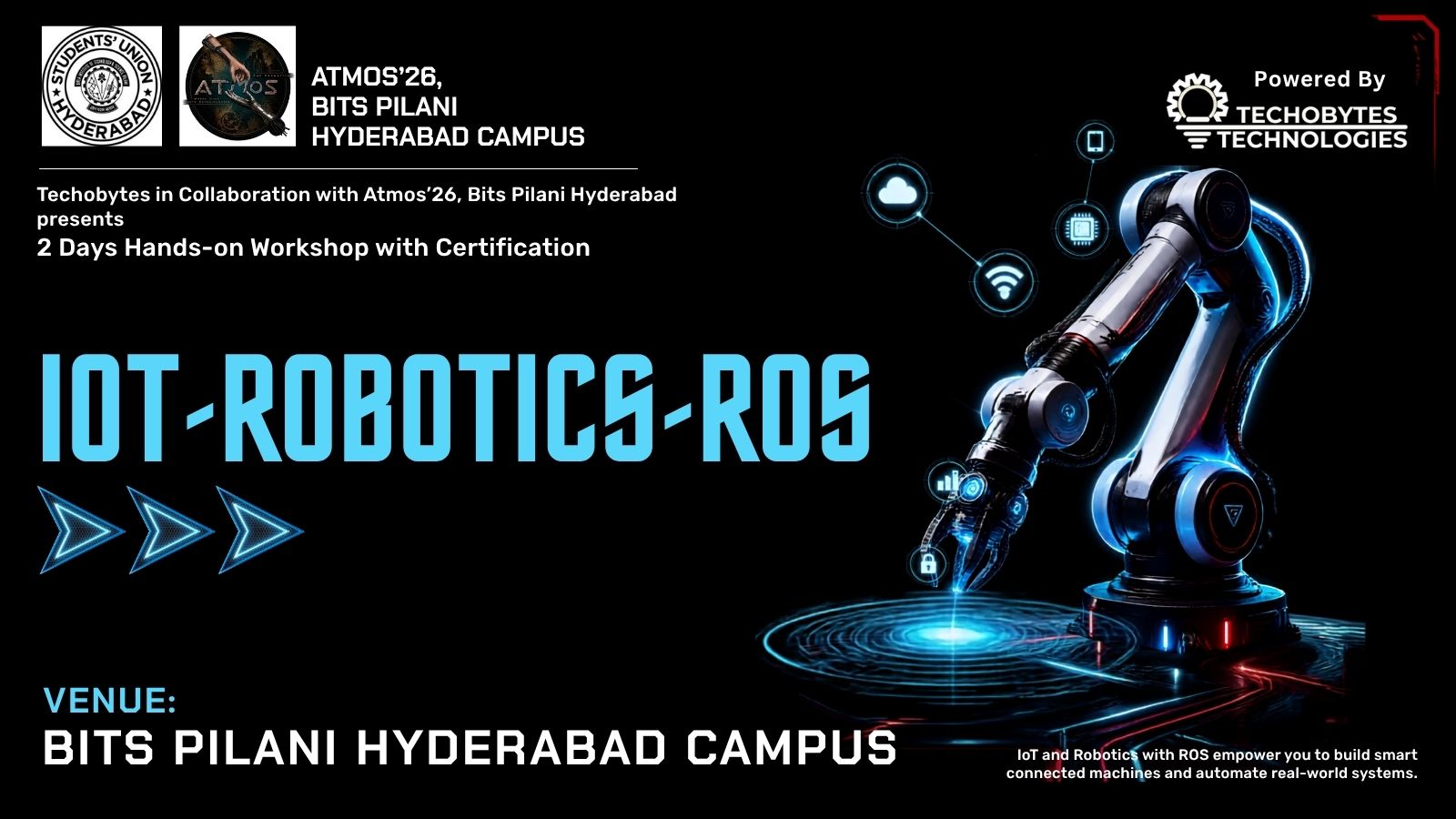
About the event
AI • IoT • Robotics • ROS
2 Days Hands-on Workshop with Globally recognized Certification
Venue: Bits Pilani, Hyderabad Campus
Note: Stay is also available for students only from 16 years onwards on sharing basis inside the campus from Atmos Bits Hyderabad.
Duration: 2 Days (14–16 Hours)
Eligibility: Open to all, including B.Tech, B.E., undergraduate and postgraduate students, college students, school students, and anyone interested in AI, IoT, Robotics, and ROS.
The workshop covers concepts from basic to advanced levels through hands-on learning, electronics, robotics, IoT communication, computer vision, and ROS.
Workshop Objective & Final Project
The workshop culminates in building an AI-powered object-following robot that:
• Uses ESP8266 for communication
• Receives commands from a laptop
• Uses IoT protocols for communication
• Uses OpenCV, MediaPipe, and YOLO for computer vision
• Uses ROS for software architecture
• Detects and follows objects
• Avoids obstacles
• Stops near the target object
Day 1: Electronics, Robot Building & IoT
Session 1: Introduction to Electronics & Embedded Systems
Theory:
• Microcontrollers and Arduino architecture
• Input vs. output
• Digital signals
• Sensors and actuators
• Voltage, current, and GPIO
Activity: Digital Input & Output
• LED blink
• Multiple LED patterns
• Push-button input
• LED control using a button
Learning Outcome:
• Understand digitalRead()
• Understand digitalWrite()
Session 2: Serial Communication
Theory:
• UART
• Serial Monitor
• Data transmission basics
Activity:
• Read user input from Serial Monitor
• Control LEDs using serial commands
• Create a simple command interface
Learning Outcome: Understand human-to-microcontroller communication.
Session 3: Robot Building Workshop
Hardware Assembly:
• Chassis assembly
• Motor driver integration
• Wheel mounting
• Power connections
• ESP8266/Arduino integration
Activity: Robot Movement Programming
• Forward
• Backward
• Left
• Right
• Stop
Learning Outcome: Build and program a functional mobile robot.
Session 4: IoT Fundamentals
• Introduction to IoT
• Client-server architecture
• Local vs. internet communication
• TCP vs. UDP
Session 5: Wi-Fi & Access Point Mode
Theory:
• Station mode
• Access Point mode
• Network basics
Activity:
• Configure ESP8266 as an Access Point
• Connect a laptop or mobile device
Session 6: HTTP Communication
Theory:
• Requests and responses
• GET and POST
• REST concepts
Activity:
• Send commands to ESP8266 using a browser
• Control the robot through HTTP
Session 7: MQTT Communication
Theory:
• Publish/Subscribe model
• Broker architecture
• Real-time communication
Activity:
• Publish messages
• Subscribe to robot commands
• Enable remote robot control
Session 8: UDP Communication
Theory:
• Low-latency communication
• Use cases in robotics
Activity:
• Send movement commands using UDP
Day 1 Deliverables
✓ Functional robot
✓ Serial communication
✓ Wi-Fi connectivity
✓ HTTP control
✓ MQTT control
✓ UDP communication
Day 2: AI Vision & ROS
Session 1: Introduction to Computer Vision
• Introduction to OpenCV
• Image processing basics
• Camera fundamentals
Session 2: OpenCV Activities
• Webcam access
• Image capture
• Drawing shapes
• Colour detection
Session 3: MediaPipe
Theory:
• Landmark detection
• Human pose estimation
Activity:
• Hand tracking
• Body tracking
• Gesture recognition
Session 4: YOLO Object Detection
Theory:
• AI-based object detection
• Bounding boxes
• Confidence scores
Activity:
• Detect everyday objects
• Real-time object tracking
Session 5: ROS Overview
• What is ROS?
• Why ROS?
• ROS architecture
• Nodes and communication
Session 6: ROS Environment Setup
Activity:
• WSL installation
• ROS installation
• Workspace creation
Learning Outcome: Create a first ROS workspace.
Session 7: ROS Topics
Theory:
• Publisher
• Subscriber
Activity:
• Create a Publisher node
• Create a Subscriber node
• Exchange messages
Session 8: ROS Messages
• Standard messages
• Custom messages
Session 9: ROS Services
Theory:
• Request/response communication
Activity:
• Service server
• Service client
Session 10: ROS Launch Files
• Create launch files
• Start multiple nodes together
Session 11: Docker for ROS
• ROS containers
• Running ROS inside Docker
Final Project: AI-Powered Object-Following Robot
Components Used:
• ESP8266
• Robot chassis
• OpenCV
• MediaPipe
• YOLO
• ROS
• MQTT/HTTP communication
Project Flow
Camera captures video
YOLO detects the target object
A ROS node processes the detection
ROS publishes movement commands
IoT communication sends commands to ESP8266
The robot moves toward the object
Obstacle avoidance logic helps prevent collisions
The robot stops near the target
Final Project Deliverables
✓ Object detection
✓ Object tracking
✓ ROS communication
✓ ESP8266 integration
✓ Robot movement
✓ Obstacle avoidance
✓ End-to-end AI robotic system
Workshop Outcome
By the end of the workshop, participants will have hands-on exposure to:
• Electronics fundamentals
• Arduino programming
• Serial communication
• Robot building
• HTTP
• MQTT
• UDP
• OpenCV
• MediaPipe
• YOLO
• ROS Topics
• ROS Services
• ROS Messages
• ROS Launch Files
• Docker basics
• AI-powered robotics integration
Final Achievement
Build a complete AI-enabled autonomous robot from scratch.
- Things to know
Entry allowed for ages 12 and above
Tickets required for ages 12 and above
Pets are not allowed
Event will be held in English