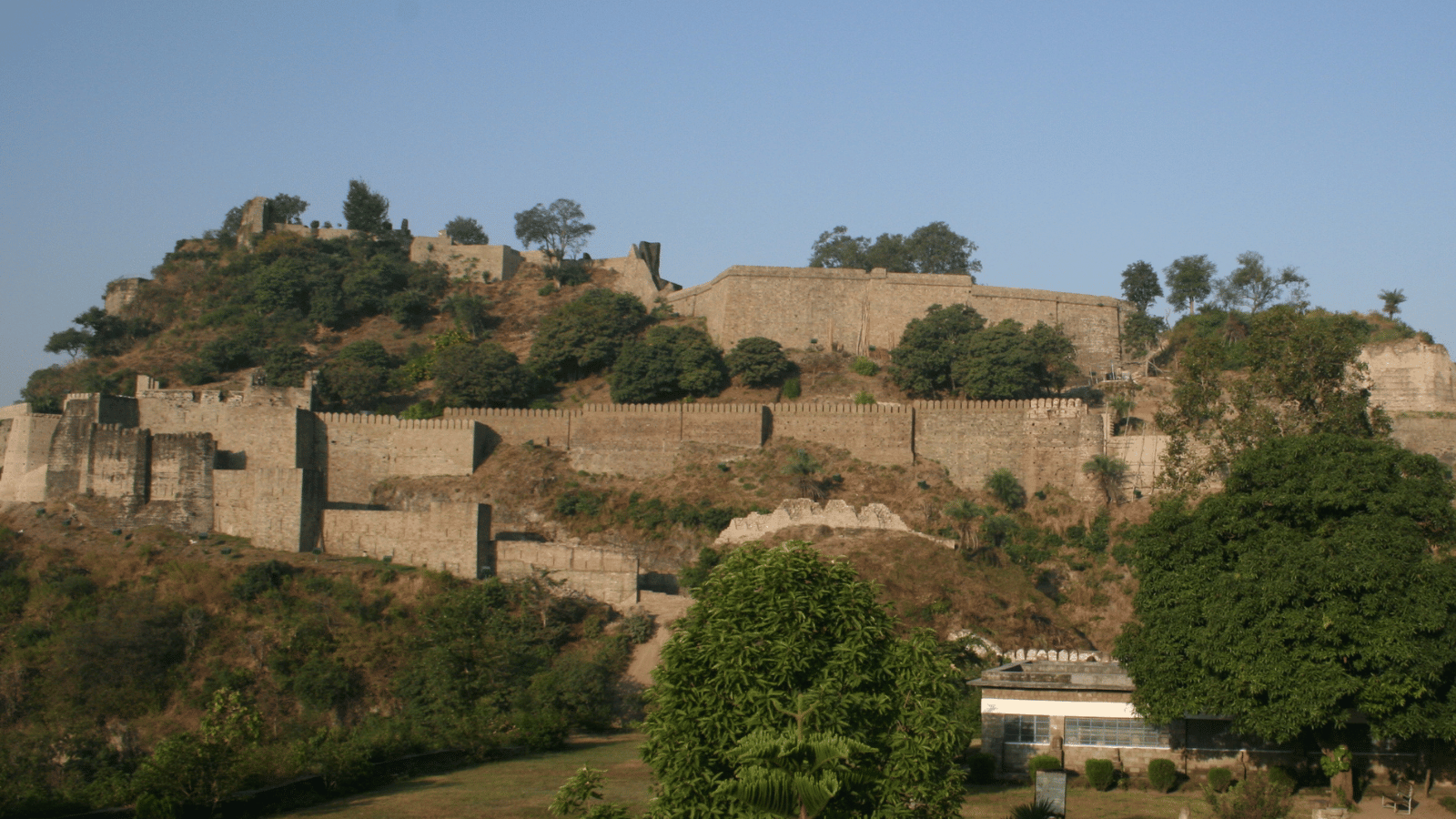
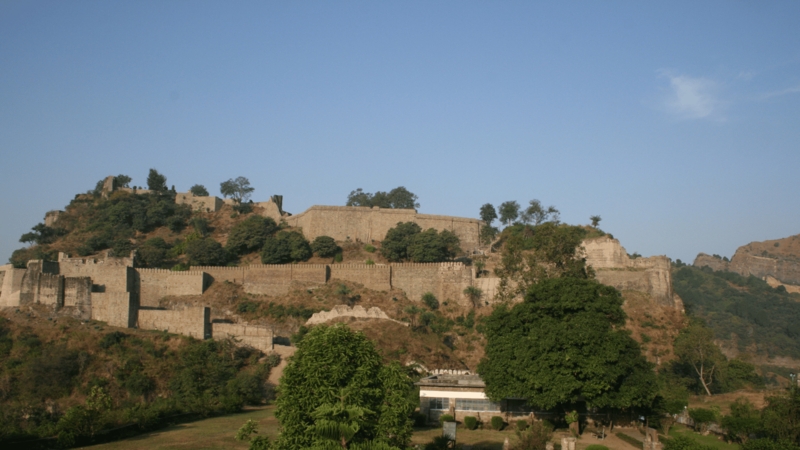
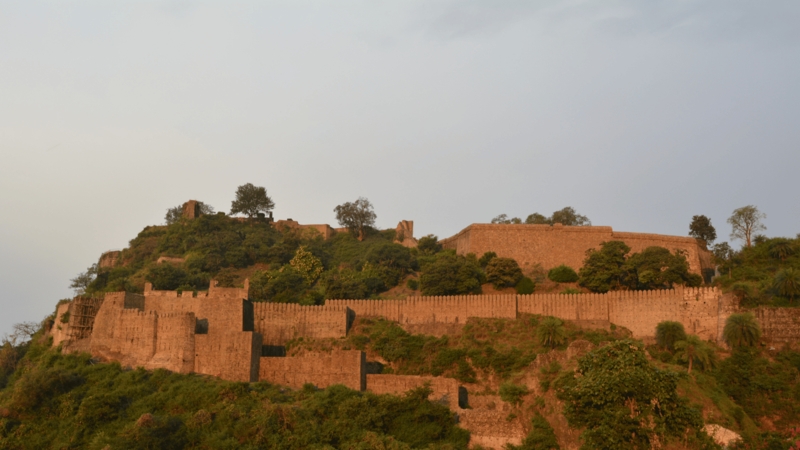
The Kangra Fort stands prominently atop a ridge between the Manjhi and Banganga rivers, commanding a dramatic natural setting that has shaped its reputation as one of the most formidable hill forts of northern India. Its long, narrow plan follows the contours of the terrain, and the steep cliffs rising nearly 300 feet above the Banganga provide much of its defensive power. The fort reflects a layered history of strategic architecture and evolving cultural influences.
Historical Background
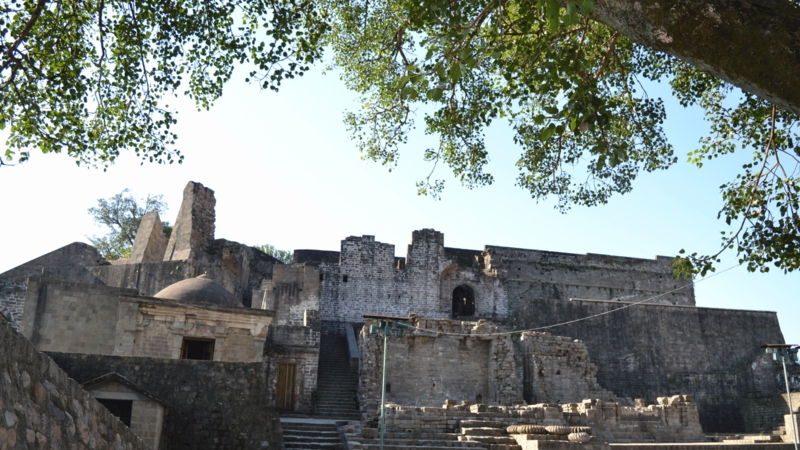
The fort’s gateways, passages, and structural modifications preserve the imprint of several ruling powers. The Phataki Gate dates to the Sikh period under Maharaja Ranjit Singh, while the Ahani Gate and Amiri Darwaza are attributed to Nawab Alif Khan, the first Mughal Governor under Jahangir. Jahangir later added the Jahangiri Darwaza after his conquest. The upper Andheri Darwaza, once a vaulted and dark corridor, and the Darsani Darwaza, flanked by defaced figures of the goddesses Ganga and Yamuna, highlight successive phases of Mughal and later architectural intervention.
Location and Significance
Located near the town of Kangra in Himachal Pradesh, the fort occupies a narrow rocky ridge that forms a natural barrier between two rivers. This placement grants the site exceptional defensive value while offering sweeping views over the surrounding landscape. Its prominence and long history make it one of the region’s most significant heritage monuments.
Architectural Materials and Design
Within the complex lie shrines dedicated to Lakshmi Narayana, Sitala, and Ambika Devi, as well as remains of a Jaina monastic complex. A staircase once connected these shrines to the palace known as the Sheesh Mahal through the Mahalon ka Darwaza. The rear sections contain the Barood Khana, a masjid, an execution hall, tanks, wells, a Shiva temple, a baradari, and additional service structures. Near the main Ranjit Singh Gate stand a hammam and a British cemetery, further illustrating the fort’s layered architectural landscape.

 4.4•
4.4•
 Ticket needed for all ages
 Entry allowed for all ages
 Kid friendly
 Pets not allowed
 Washrooms available
 Free parking
 Kushh
Kushh Dr Yogesh Chaudhari
 Manas Behera
 Sandeep Bhattacharya
 Pramod Ranganath