The Buddhist caves of Junagadh present an enduring testament to the cultural and spiritual legacy of the Indian subcontinent. Carved into the foothills of the Girnar range, they demonstrate the artistic discipline and scholarly vibrancy of Buddhist communities active between the 1st and 4th century C.E.
Historical Background
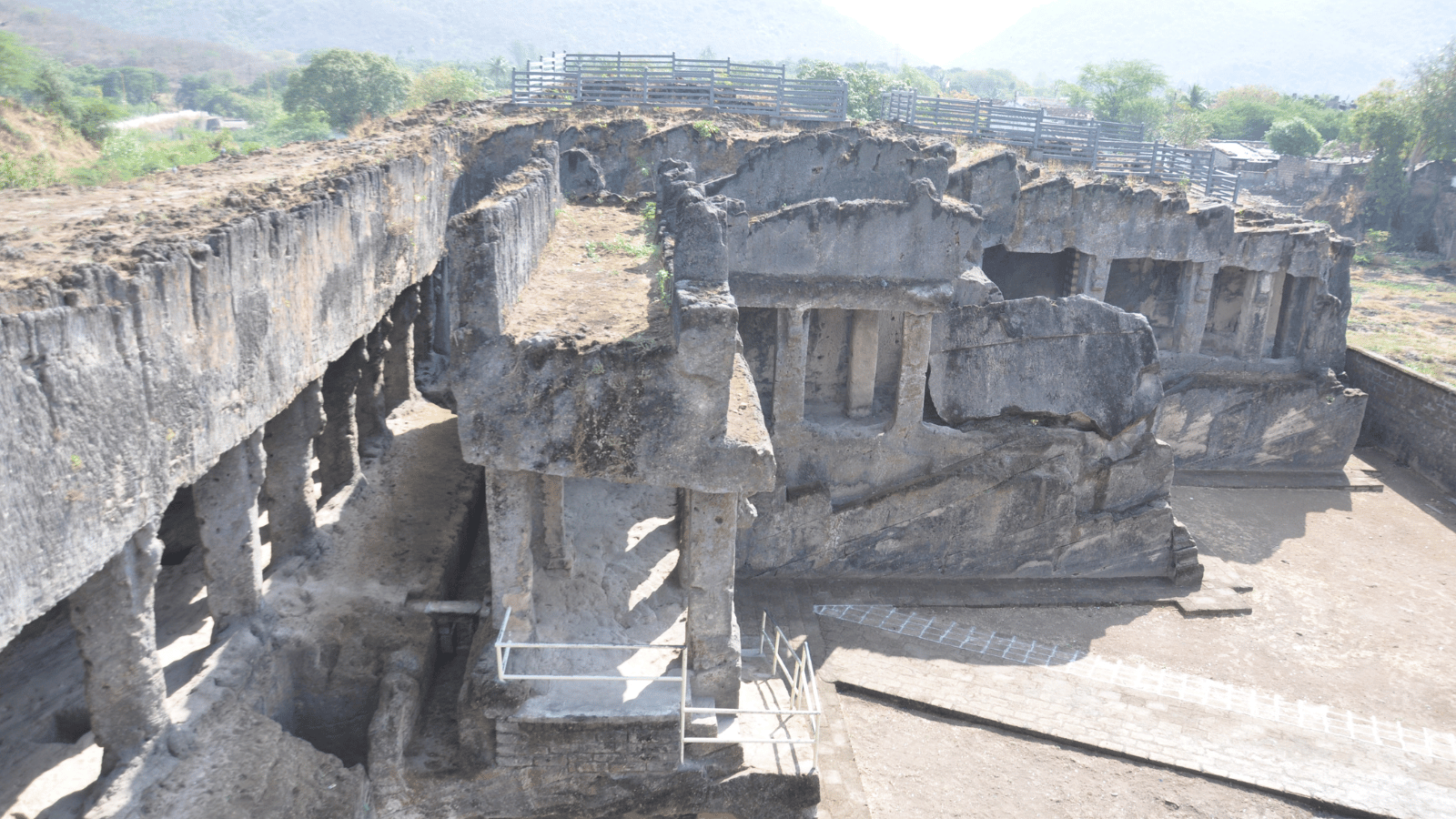
The caves were first recorded in 1822 by British archaeologist Sir James Todd. The Baba Pyare group, influenced by Satavahana artistic traditions, is generally assigned to the 1st to 2nd century C.E. The Khapra Kodiya group, known for its plain surfaces and inscriptions in short cursive script, is associated with the 3rd to 4th century C.E., providing evidence of changing patterns of habitation and monastic practice.
Location and Significance
Situated in Junagadh, Gujarat, the caves reveal a thriving center of Buddhist learning shaped by evolving architectural and devotional requirements. Their inscriptions, structural variety, and symbolic richness offer valuable insight into regional religious life.
Architectural Materials and Design
The Baba Pyare group contains three rock cut levels, including spacious cells, courtyards, pillars, and door frames decorated with symbols such as the swastika, triratna, and ankush. The Khapra Kodiya caves feature a longitudinal ridge, a western wing with water tank grids, and a U shaped residential wing for monks. Together they display both functional monastic planning and refined artistic expression.

 4.3•
4.3•
 Ticket needed for all ages
 Entry allowed for all ages
 Kid friendly
 Pets not allowed
 Free water stations
 Washrooms available
 Hardik Ataliwala
 Jaimin Goswami
 Sakib Mulla
 prabhat singh
 himanshu bhatt