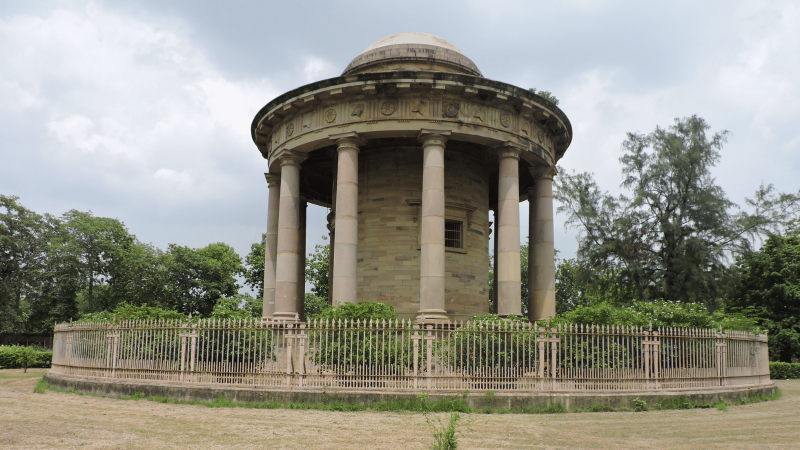
Lord Cornwallis Tomb

About
The tomb of Lord Cornwallis in Ghazipur is a commemorative structure honoring his service in significant global and colonial events. It reflects the reverence accorded to him after his death on 5 October 1805 C.E. and stands as a stately architectural monument overlooking the Ganges.
Historical Background
Cornwallis was noted for his involvement in the American Revolutionary War and later for his tenure as Governor General of India. Following his death in Ghazipur, this memorial was constructed to preserve his legacy. The monument was formally declared a centrally protected monument in 1920 C.E.
Location and Significance
Located in Ghazipur, Uttar Pradesh, the tomb commands a distinguished position near the Ganges. Its placement enhances its commemorative purpose and affirms the region’s historical association with Cornwallis.
Architectural Materials and Design
The structure features a dome supported by twelve columns rising from a circular platform. The dome bears ornamentation of an army cap and floral motifs. At the center lies a white marble bust of Cornwallis on a square base, encircled by sculpted figures of a Brahmin, a Muslim, a European, and a native soldier. An English epitaph rests below this raised element. Double storied gateways embellished with spears, bows and arrows, swords, and inverted cannons enrich the monument’s visual character.


What you’ll experience
A serene riverside memorial rich in colonial history.
Special attractions
Intricate dome carvings and detailed gateway weapon motifs.
Perfect for
Heritage enthusiasts seeking quiet historical reflection.


Gallery