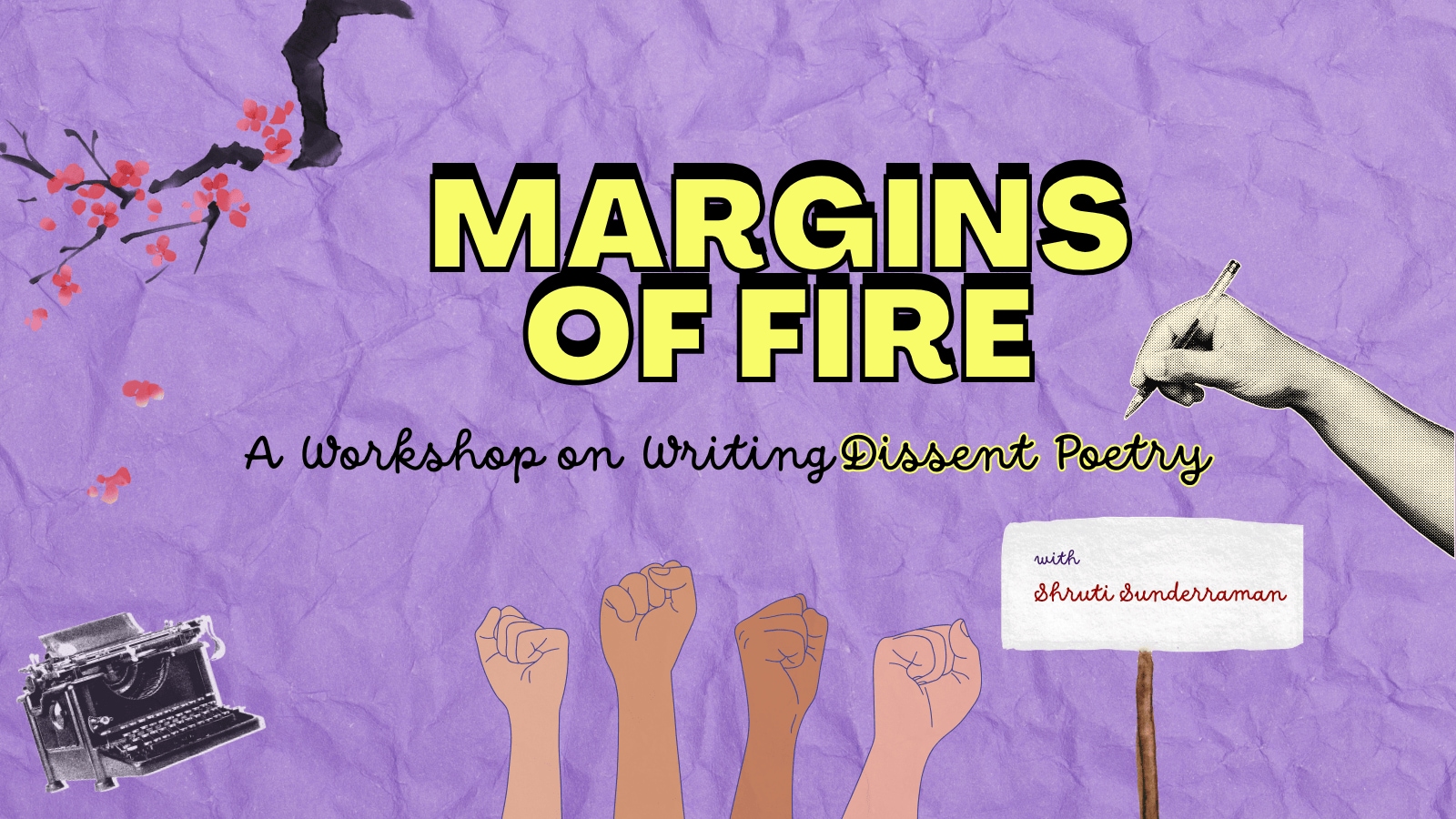
Margins of Fire is a writing workshop on poetry as dissent where we learn what it means to write from the edges, against silence, and in moments where language feels both insufficient and necessary.
Poetry may sometimes be considered a “soft” art but it has a long history of holding up protest spine. Apart from human rights, oppressive regimes have historically targeted the policing of leisure, art, and communion as a tool to curb education, organisation, agitation, and pleasure.
This workshop offers a space to reclaim our democratic right to dissent, through the art of writing poems. This is an opportunity to understand the political power of allowing yourself to feel your anger, and express it through poetry from a place of that understanding.
What does it mean to write when you are unheard, misheard, or deliberately erased? What does it mean to write anyway?
Through the work of selective poets and through some collective exercises, we’ll explore how to write poetry that can hold your anger, contradiction, grief, and refusal. “Perfect” poems are highly discouraged. We sit with the mess and we write write write. :)
This is a space for people across levels of writing experience. I believe the best poems are simple. So, you don’t need to identify as a poet, just someone curious about poetry, and wanting to write.
Also good if you’re lagging behind on #GloPoWriMo2026 and want to write in the company of other poets. :)
What We’ll Do
This will be a writing-focused session, with the first half dedicated to guided discussion and the second half to generative writing.
Discussion and Exercises (First Half)
We’ll begin by collectively thinking through questions like:
• What makes a poem an act of dissent?
• The role of anger in how we organise. Is it possible to sustain anger without burning out?
• What does “writing from the margins” mean to you personally, politically, or linguistically?
• Can poetry hold anger without explanation? How to unlearn what we taught are to soften or justify?
• Who are you writing to when you write a poem of resistance?
• What is the role of vulnerability in political writing?
• The structure and lyricalities we can apply to writing dissent poems.
• How to think about dissent narratives in poetry.
• The big one: Hope as dissent and writing about it.
Writing (Second Half)
The second half will be dedicated to writing.
We’ll offer a set of prompts designed to help you:
• Write from a place you’ve been told to silence
• Speak up against injustice
• Rework a personal memory as a political text
• Use fragmentation, repetition, or rupture as form
Address something (or someone) you cannot speak to directly
Staying soft with yourself while doing hard things
You can write privately, share if you want to, or simply sit with the process. There is no expectation to produce a “finished” piece.
What to Bring:
• Something to write on (notebook, phone, laptop—whatever works for you)
• Any text, line, or fragment you’ve been holding onto (optional)
Who is Shruti?
Shruti Sunderraman is an award-winning writer and editor who has spent over a decade as a journalist covering gender, health, culture, and science. She’s been writing and publishing poems longer than that, with her work published in an anthology collection and several literary magazines and online publications. She’s also actively built a poetry community during her time in Bombay and is now focused on building a slow writing community of poets in Bangalore. Given the on-going political and social upheaval in India and across the world, she aims to create a space for watering the seed of dissent through the time-tested art of poetry.

 Activity will be in English
 Duration 3 Hours
 Ticket needed for ages 18 and above
 Entry allowed for ages 18 and above
 Seating Arrangement Seated
 Kids not allowed
 Pets not allowed