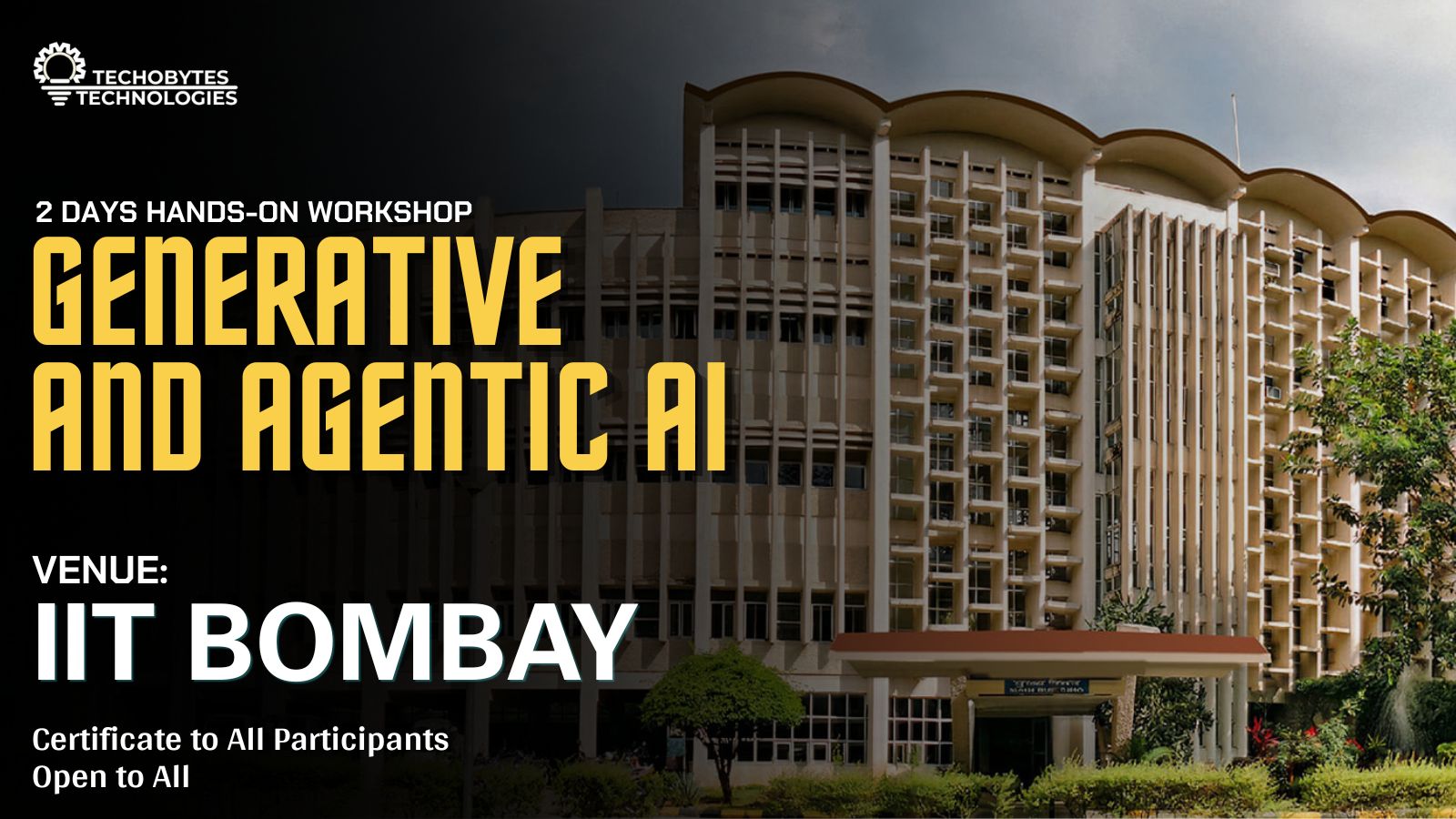
Mastering Generative and Agentic AI | 2 Days Workshop at IIT Bombay
About the event
2 Days Workshop on Mastering Generative & Agentic AI
From AI Foundations to Building Intelligent Agents
Duration: 2 Days | 14 Hours of Training
Eligibility: Engineering, biomedical and other students, researchers, and working professionals interested in AI. Basic Python familiarity is recommended.
Day 1: Generative AI Foundations & Applications
1. Introduction to Generative & Agentic AI
Introduction to AI, Machine Learning, Deep Learning and Generative AI.
Differences between Generative AI, AI assistants and AI agents.
Applications across education, engineering, healthcare and business.
Overview of language, image and multimodal models.
2. Transformers & Large Language Models
Conceptual introduction to transformers and attention.
Tokens, embeddings and context windows.
Overview of GPT, Claude, Gemini and open-weight models.
Introduction to pre-trained models and Hugging Face.
Practical: Compare model responses using different prompts.
3. Prompt Engineering & Structured Outputs
Write effective prompts using instructions, context and examples.
Use system instructions and reusable prompt templates.
Generate structured JSON responses.
Understand hallucinations and basic output validation.
Hands-on: Create prompts for information extraction and summarization.
4. Building LLM Applications
Connect a Python application to an LLM API.
Introduction to LangChain and prompt templates.
Manage conversation history and context.
Understand API keys, token usage and basic cost controls.
Hands-on: Build a simple conversational AI assistant using a starter project.
5. Retrieval Augmented Generation (RAG)
Understand RAG and when to use it.
Load PDF documents and split them into chunks.
Generate embeddings and understand vector similarity search.
Introduction to FAISS or Chroma.
Retrieve relevant information and generate document-grounded answers.
Include source references and handle unanswered questions.
Hands-on: Build a PDF question-answering assistant using a prepared starter project.
6. Model Adaptation & Responsible AI
When to use prompting, RAG or fine-tuning.
Conceptual introduction to Parameter-Efficient Fine-Tuning (PEFT).
Data privacy, bias, hallucinations and responsible AI use.
Discuss when model adaptation is justified in real-world projects.
Day 1 focus: Understand LLM fundamentals and build a conversational assistant and a basic document-based RAG application.
Day 2: Agentic AI & Workflow Automation
7. AI Agent Foundations
Components of an AI agent: model, instructions, tools, memory and control logic.
Understand the plan–act–observe cycle.
Compare predefined workflows with agent-driven decisions.
Identify practical use cases and limitations.
Demonstration: Observe how an agent decides which action to take.
8. Tool Calling & API Integration
Define tools and their input schemas.
Understand how an LLM requests tool execution.
Connect an LLM to a calculator and document retrieval function.
Validate tool inputs and handle basic execution errors.
Hands-on: Extend the Day 1 assistant to select and invoke tools.
9. Agent Workflows with LangGraph
Introduction to graph-based orchestration.
Understand nodes, edges, state and conditional routing.
Build a simple multi-step workflow.
Add a basic validation step and human approval checkpoint.
Hands-on: Create a workflow that retrieves information, drafts an answer and routes it for review.
10. Agentic RAG & Multi-Agent Collaboration
Understand when an agent should retrieve information.
Review retrieved information before generating an answer.
Introduction to researcher, writer and reviewer agent roles.
Demonstration: Extend the existing document assistant with a retrieval decision and review step.
Scope: Conceptual discussion and guided demonstration, without implementing a separate multi-agent system.
11. Capstone Project: Intelligent Document & Research Assistant
Build on the Day 1 RAG application and extend it with Day 2 agent concepts.
Accept user questions about uploaded documents.
Retrieve relevant information and provide source references.
Call a tool when required.
Generate a structured response.
Validate the answer and request human approval before a designated action.
Run the application through a basic Streamlit interface.
Implementation approach: Participants extend a prepared starter project. The trainer provides the core retrieval pipeline and application structure so participants can focus on integration and understanding.
Workshop Outcomes
By the end of the workshop, participants will have practical experience in:
Understanding Generative AI, LLMs and AI agents.
Writing effective prompts and generating structured outputs.
Building an LLM-powered conversational assistant.
Creating a document question-answering system using RAG.
Connecting AI applications to tools and APIs.
Building a basic controlled workflow with LangGraph.
Extending a starter project into an intelligent document and research assistant.
Understanding the limitations and safety considerations of agentic applications.
Workshop positioning: A two-day, hands-on introduction to Generative AI and Agentic AI, culminating in one integrated project—not complete mastery of both fields.
- Things to know
Entry allowed for ages 15 and above
Tickets required for ages 15 and above
Pets are not allowed
Event will be held in English, Hindi