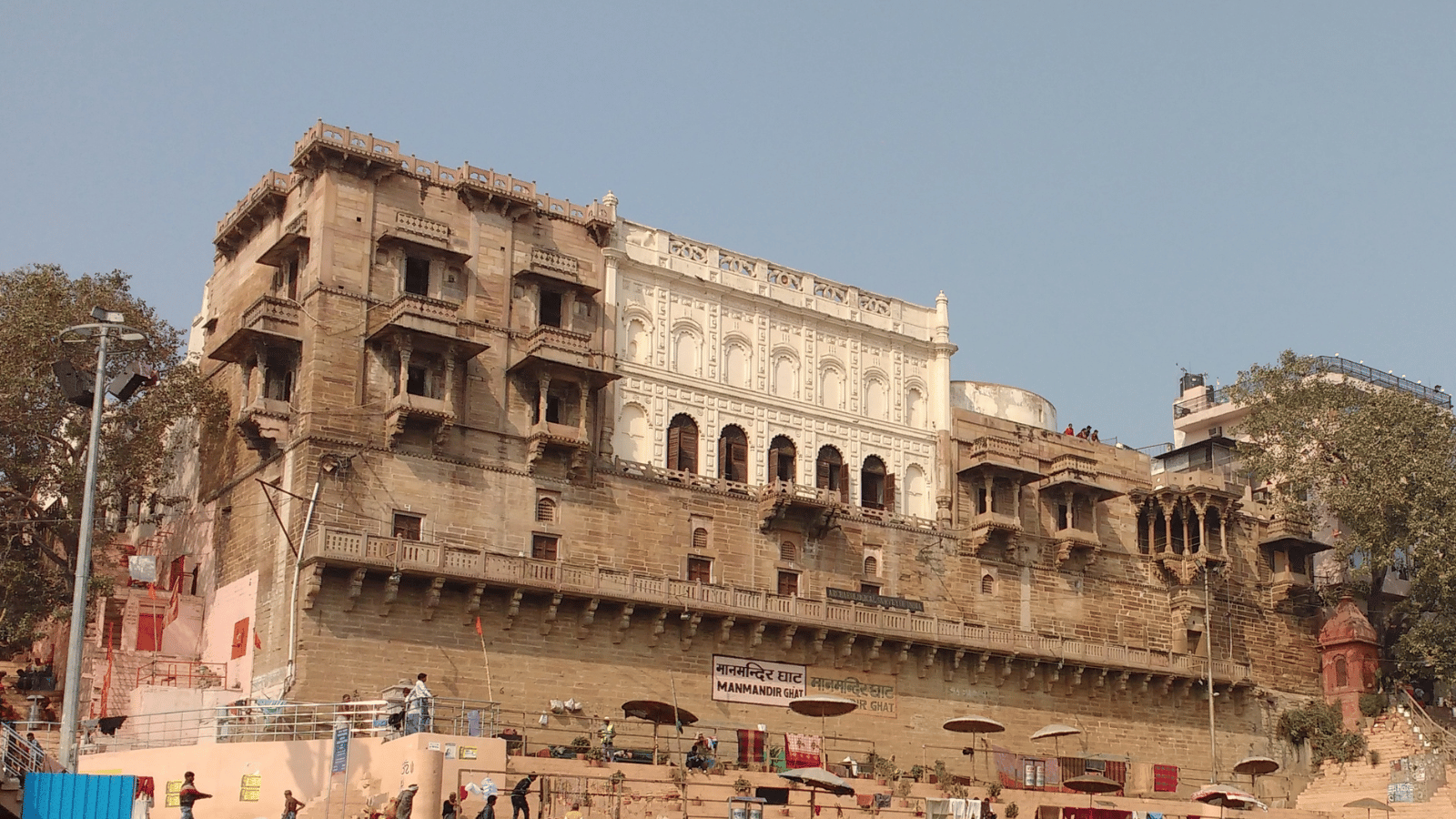
Man Mahal stands beside Dashashwamedh Ghat in Varanasi and is noted for its remarkable masonry observatory. The site reflects the disciplined architectural vision of Rajput patrons and the scientific curiosity that shaped early astronomical study in India.
Historical Background
The palace was established around 1600 C.E. by Man Singh, the Raja of Amber and a trusted general of the Mughal emperor Akbar. The observatory was added around 1737 C.E. by Sawai Jai Singh II, an accomplished astronomer, founder of Jaipur and a descendant of Man Singh. Jai Singh II also created a network of five monumental observatories at Delhi, Jaipur, Ujjain, Varanasi and Mathura, collectively known as Jantar Mantar.
Location and Significance
Located in Varanasi, Uttar Pradesh, a short distance from the Varanasi railway station, Man Mahal represents a lasting point of scientific engagement. The site highlights the commitment of Indian rulers to empirical observation and structured astronomical research.
Architectural Materials and Design
The Man Singh Observatory features a refined collection of stone instruments designed for measuring time and preparing lunar and solar calendars. Key instruments include the Samrat Yantra, Laghu Samrat Yantra, Dakshinobhiti Yantra, Chakra Yantra, Digamsa Yantra and Nari Valaya Dakshin Yantra. Their design enables accurate study of celestial positions, distances and angular movements.

 4.6•
4.6•
 Ticket needed for all ages
 Entry allowed for all ages
 Kid friendly
 Pets not allowed
 Free water stations
 Washrooms available
 Stroller Shravan
 Divya
Divya Shekhar A
 Anshika Jain
 Kanika Banerjee