Quantum Computing - 45 Hrs Summer Training Program'26
About
About the Event
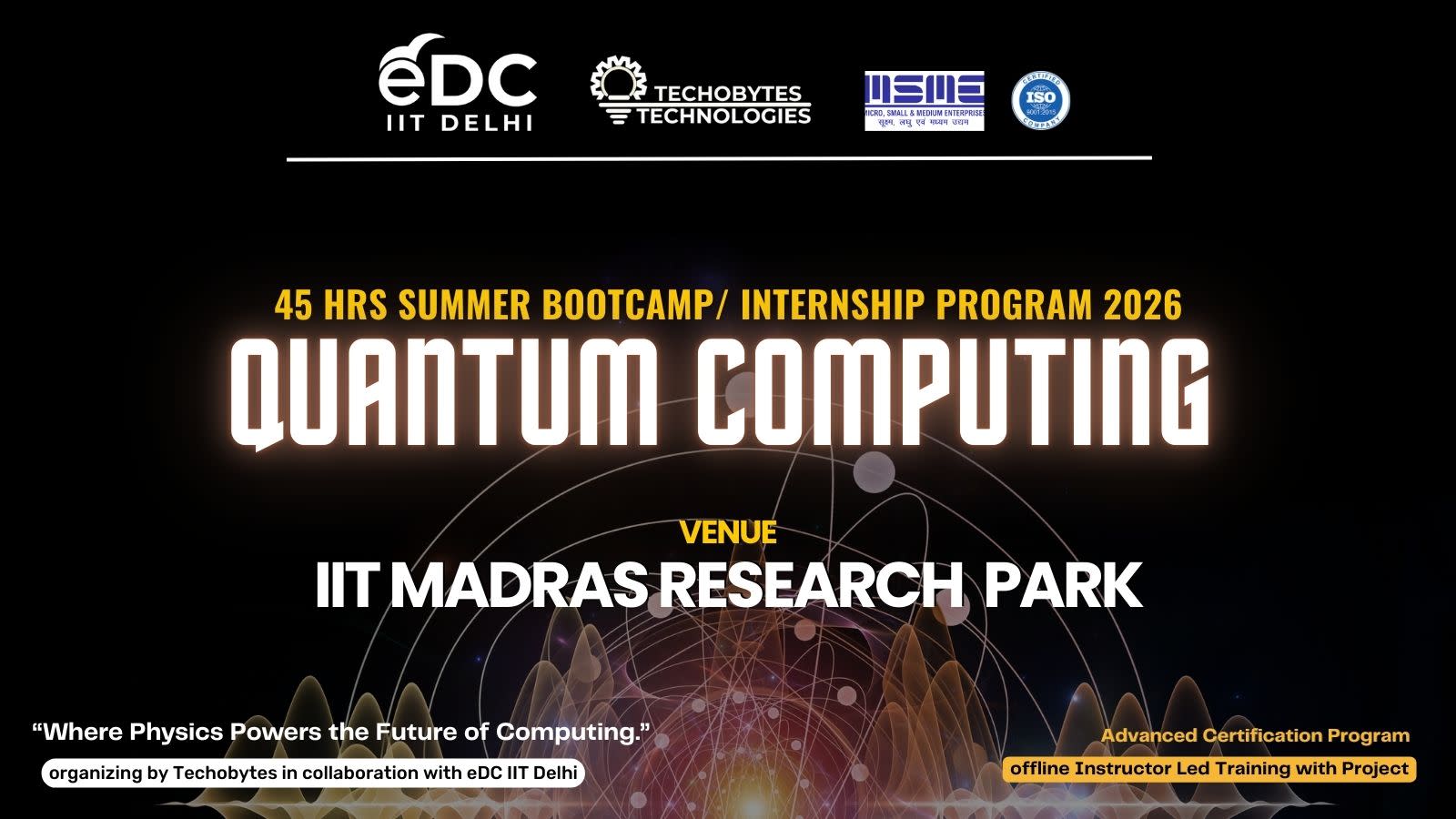
40-45 HOUR SUMMER BOOTCAMP/INTERNSHIP PROGRAM 2026 WITH PROJECT AT IIT MADRAS RESEARCH PARK BY TECHOBYTES IN COLLABORATION WITH EDC IIT DELHI
About Techobytes
Techobytes Technologies is recognised as a leading expert in the design and delivery of technical, soft and hard skills training from individual courses and seminars to certification programs and full-scale training solutions, from classroom training to online training.
Duration: The event is scheduled for 6 consecutive days, from 15th June 2026 to 20th June 2026.
The training will include 40-45 hours of intensive learning with a project, covering concepts from basic to advanced level.
Note: Candidates opting for the offline course in Chennai will also receive access to one complimentary 40 HRS online course of their choice.
Benefits and certification:
- 40-45 hours certification/internship program.
- 3 certificates in each training. (Participation Certificate + Recommendation/Internship Certificate + Project Completion Certificate)
- Updated industry-equipped curriculum.
- Work on live projects.
- Hands-on training by certified trainers from the industry.
- Complimentary resume and CV building session.
- Get an opportunity to attend a technical workshop from Techobytes in IIT’s.
Eligibility: Final Year, B.tech, B.E, M.B.B.S, BCA, MCA, MS, MD, B.sc IT, M.sc IT, Biomedical, Bio-Technology, BBA, MBA, B.A, hobbyist and from any other stream can join the workshop.
Quantum Computing Fundamentals (Timeline Approx 20 HRS)
Module 1: Introduction to Quantum Mechanics and Computation
The Quantum Realm and Its Computational Promise:
○ Defining Quantum Computing: Superposition, entanglement, and their potential.
○ Applications Landscape: Overview of potential impact in medicine, materials science, AI, finance, etc.
○ Moore's Law and its Limits: Motivation for exploring alternative computational paradigms.
○ Current Status and Future Trends: Overview of the quantum computing ecosystem and research directions.
● Classical vs. Quantum Computation:
○ Bits vs. Qubits: Information representation, storage, and manipulation. ○ Classical Logic Gates: Truth tables, Boolean algebra, circuit model.
○ Quantum Gates vs. Classical Gates: Reversibility, superposition, and
entanglement.
○ Computational Complexity (Brief): Introduction to the idea of problem difficulty
and potential quantum speedup.
● Foundations of Quantum Behavior:
○ Quantum States: State vectors in Hilbert space, probability amplitudes.
○ Superposition: Linear combination of states, physical implications.
○ Measurement: Projective measurement, Born rule, wave function collapse.
○ Physics Focus: Introduction to basic quantum mechanical principles:
quantization, wave-particle duality (briefly), and the probabilistic nature of quantum phenomena.
Module 2: Qubits and Quantum States ● The Quantum Bit (Qubit):
○ Two-Level Systems: Physical realization of qubits (e.g., spin-1/2 particles,energy levels of atoms).
○ State Vector Representation: Column vectors, basis states ∣0⟩ and ∣1⟩. ○ Bloch Sphere Introduction: Visualizing qubit states.
○ Mixed States (Brief): Introduction to density matrices.
● Dirac Notation (Bra-Ket Notation):
○ Vectors and Inner Products: Complex vector spaces, Hermitian inner product. ○ Ket Vector ∣ψ⟩: Representing quantum states.
○ Bra Vector ⟨φ∣: Adjoint of ket vector.
○ Inner Product ⟨φ∣ψ⟩: Probability amplitudes, orthogonality.
○ Normalization: Ensuring valid quantum states.
● Quantum Superposition:
○ Mathematical Formalism: ∣ψ⟩=α∣0⟩+β∣1⟩, complex amplitudes.
○ Physical Interpretation: A qubit existing in a combination of ∣0⟩ and ∣1⟩ simultaneously. ○ Phase: Relative phase between superposition components and its importance.
○ Physics Focus: Detailed discussion of the physical systems used for qubits, linking their quantum properties to the mathematical representation.
Module 3: Quantum Measurement and Single-Qubit Evolution ● Quantum Measurement:
○ Measurement in Computational Basis: Projectors, probabilities.
○ General Measurements: Measurement operators, POVMs (brief introduction). ○ The Collapse Postulate: State update after measurement.
○ No-Cloning Theorem: Implications for quantum information processing.
○ Physics Focus: In-depth discussion of the measurement problem in quantum mechanics and its interpretations.
● Single-Qubit Gates:
○ Pauli Gates (X, Y, Z): Matrix representation, circuit symbols, action on Bloch sphere.
○ Hadamard Gate (H): Creating superposition, its matrix and circuit symbol.
○ Phase Gate (S) and T Gate (π/8): Introducing phase shifts.
○ Rotation Gates (Rx,Ry,Rz): Continuous rotations on the Bloch sphere, relation to physical manipulations.
○ Universality (Brief): Introduction to the idea of a universal gate set.
○ Physics Focus: Linking these gates to physical operations on qubits, such as applying electromagnetic pulses with specific properties (duration, frequency,
phase).
Module 4: Bloch Sphere Representation and Quantum Entanglement ● Bloch Sphere:
○ Pure States on the Bloch Sphere: Mapping qubit states to points.
○ Angles and State Representation: Relation between (θ,φ) and α,β.
○ Geometric Action of Gates: Visualizing gate operations as rotations.
○ Mixed States and Density Matrices: Introduction to representing probabilistic
ensembles of quantum states.
○ Physics Focus: Using the Bloch sphere as a geometric analogy to understand the abstract mathematical space of qubit states.
● Quantum Entanglement:
○ Multi-Qubit Systems: State space, basis states.
○ Entangled States: Bell states, GHZ states, separability.
○ Non-Locality: Correlations beyond classical explanations.
○ Entanglement as a Resource: Applications in quantum computing and communication.
○ Physics Focus: Detailed discussion of the physical implications of entanglement, Bell's theorem, and experimental verification of non-locality.
Module 5: Multi-Qubit Systems, Tensor Products, and Basic Quantum Circuits ● Multi-Qubit Systems:
○ State Space: Exponential growth with number of qubits. ○ Basis States: Representing states of multiple qubits.
○ Partial Measurement: Measuring subsets of qubits.
○ Physics Focus: How interactions between physical qubits lead to multi-qubit States.
● Tensor Products:
○ Combining State Vectors: Mathematical operation.
○ Tensor Product of Operators: Applying gates to subsystems.
○ Physics Focus: Connecting the mathematical formalism to the physical
independence or correlation of subsystems.
● Basic Quantum Circuits:
○ Circuit Symbols and Notation.
○ Implementing Single-Qubit Gates in Cirq.
○ The CNOT Gate in Cirq: Creating entanglement.
○ Simple Circuit Simulation in Cirq.
○ Cirq Focus: Initial hands-on exercises building and simulating basic circuits.
Advanced Topics and Applications (Timeline Aprox 25 HRS) Module 6: Two-Qubit Gates and the Dawn of Quantum Algorithms
● Two-Qubit Gates (3 Hours):
○ CNOT Gate: Matrix, circuit symbol, action on entangled states in Cirq.
○ CZ, SWAP, Controlled-Phase Gates: Matrix, circuit symbols, implementation in Cirq. ○ Universality of Two-Qubit Gates: CNOT as an entangling gate
○ Building Multi-Qubit Circuits in Cirq.
○ Physics Focus: Physical mechanisms for implementing two-qubit gates and generating entanglement in different hardware.
● Introduction to Quantum Algorithms (2 Hours):
○ Quantum Parallelism: Evaluating functions on superpositions.
○ Quantum Interference: Enhancing desired outcomes, suppressing others. ○ High-Level Overview of Quantum Speedup.
○ Introduction to the algorithms covered later.
Module 7: Essential Math for Quantum Computing (4 Hours) ● Vector Spaces (1.5 Hours):
○ Complex Vector Spaces, Subspaces, Span.
○ Linear Independence, Basis, Dimension.
○ Inner Product, Norm, Orthogonality, Orthonormal Basis. ○ Hilbert Spaces: Finite-dimensional case.
● Linear Transformations (1.5 Hours):
○ Matrices as Linear Operators.
○ Matrix Multiplication, Identity and Inverse Operators.
○ Adjoint and Hermitian Operators: Observables in quantum mechanics. ○ Unitary Operators: Quantum gates, preserving probability.
● Eigenvalues and Eigenvectors (1 Hour):
○ Definition and Physical Significance (measurement outcomes).
○ Diagonalization of Hermitian Operators.
○ Physics Focus: Connecting the mathematical structures to the physical
concepts of quantum states, observables, and dynamics.
Module 8: Quantum Communication and Foundational Algorithms (4 Hours) ● Quantum Teleportation (2 Hours):
○ Protocol Steps: Entanglement preparation, Bell measurement, classical communication, unitary operation.
○ No-Cloning Theorem Revisited.
○ Implications for quantum networks.
● Quantum Key Distribution (BB84 Protocol) (1.5 Hours):
○ Quantum Cryptography Principles: Security based on quantum laws.
○ BB84 Protocol: Key generation, transmission, error checking, eavesdropping Detection.
○ Security Analysis.
● Deutsch–Jozsa Algorithm (0.5 Hours):
○ Problem Statement and Classical Complexity. ○ Quantum Circuit and its operation.
○ Demonstrating quantum advantage.
Module 9: Important Quantum Algorithms (5 Hours) ● Grover’s Algorithm (3 Hours):
○ Unstructured Search Problem.
○ Amplitude Amplification: Geometric visualization. ○ Grover Iteration: Quantum circuit and steps.
○ Quadratic Speedup Analysis.
○ Implementation in Cirq.
● Quantum Fourier Transform (QFT) (2 Hours):
○ Classical Discrete Fourier Transform (DFT) Review.
○ Quantum Fourier Transform Circuit.
○ Inverse QFT.
○ Applications (brief mention: phase estimation, Shor's).
Module 10: Quantum Error Correction, Hardware, and Programming (3 Hours) ● Quantum Error Correction (1.5 Hours):
○ Decoherence and Errors: Types of noise affecting qubits.
○ Classical Error Correction Analogies.
○ Quantum Error Correcting Codes: Bit-flip, phase-flip codes (conceptual). ○ Surface Code (Brief Introduction).
● Quantum Hardware and Real-World Systems (1 Hour):
○ Overview of Quantum Computing Platforms: Superconducting, trapped ions, photonic, etc.
○ Strengths and Weaknesses of Different Architectures.
○ Current Limitations and Challenges.
○ Physics Focus: Brief overview of the physical principles behind different hardware implementations.
● Interacting with Quantum Computers: Introduction to Cirq Programming (0.5 Hours):
○ More Advanced Cirq Features: Schedules, noise models (briefly).
○ Accessing Quantum Hardware (if feasible, overview of cloud platforms).
Module 11: Practical Quantum Computing and Project Exploration (3 Hours) ● Hands-on Labs with Simulators (2 Hours):
○ Implementing Grover's algorithm in Cirq for small problem sizes. ○ Creating and analyzing entangled states using Cirq.
○ Simulating basic quantum protocols (e.g., teleportation) in Cirq.
● Final Project Work/Discussion (1 Hour):
○ Student presentations or discussions of their final projects using Cirq.
Optional Module 12: Exploring Quantum Approaches to Machine Learning
● Introduction to Quantum Machine Learning: Motivation and Potential
● Basic Concepts: Quantum feature maps, kernels.
● Simple Quantum Learning Models: Variational Quantum Classifiers (VQC).
● Tools and Libraries for Quantum Machine Learning (e.g., PennyLane, Qiskit ML brief mention).
● Challenges and Future Directions of Quantum Machine Learning.
Important Notes for the Course:
● A significant portion of this course will involve understanding the underlying physics
principles that govern quantum phenomena and enable quantum computation.
● The primary quantum programming framework used throughout the practical sessions
will be Cirq.
● The time allocated to each topic within this detailed structure is approximate and may be adjusted based on the students' progress, background, and the specific learning objectives of the course.
Get an immersive learning experience. Sessions will be led by industry experts, offering hands-on practicals and a cutting-edge curriculum aligned with industry standards.
By attending, you'll not only gain valuable tech knowledge but also have the opportunity to network with industry professionals and connect with fellow participants, expanding both your skills and your professional circle.
Thanks and regards,
Techobytes Technologies