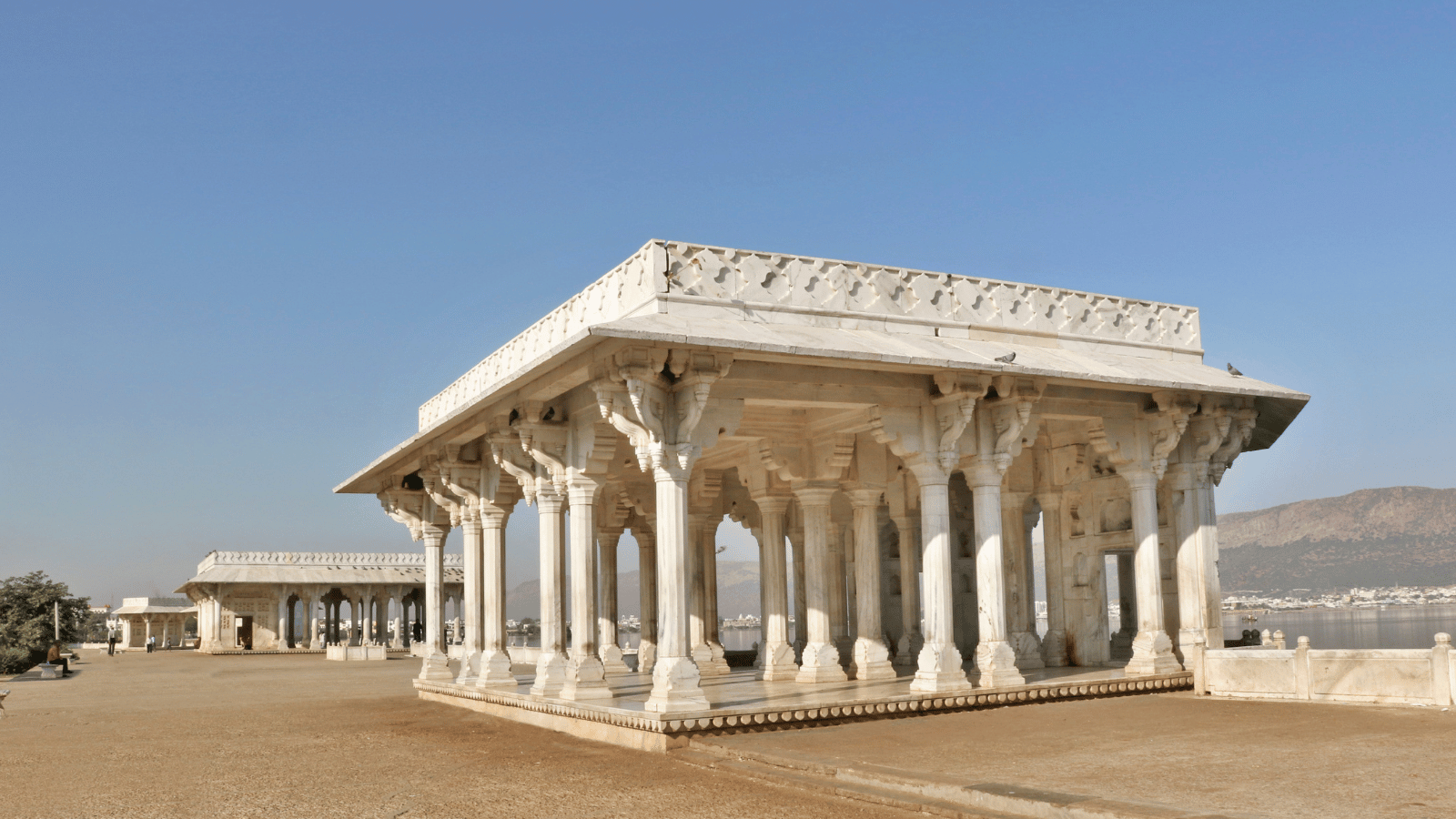
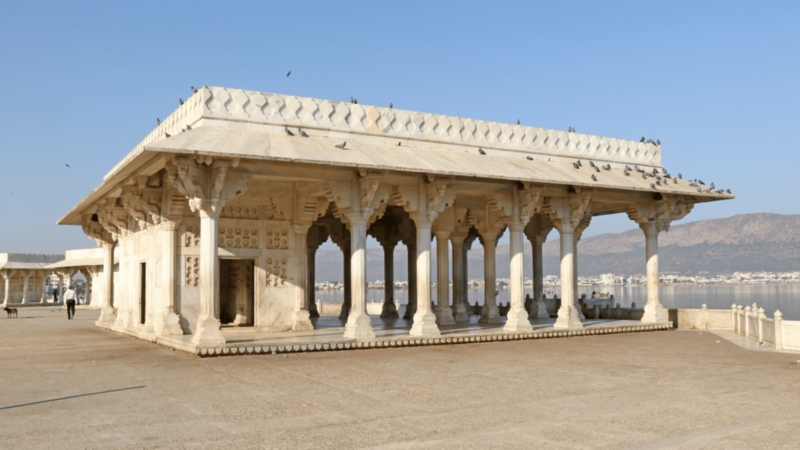
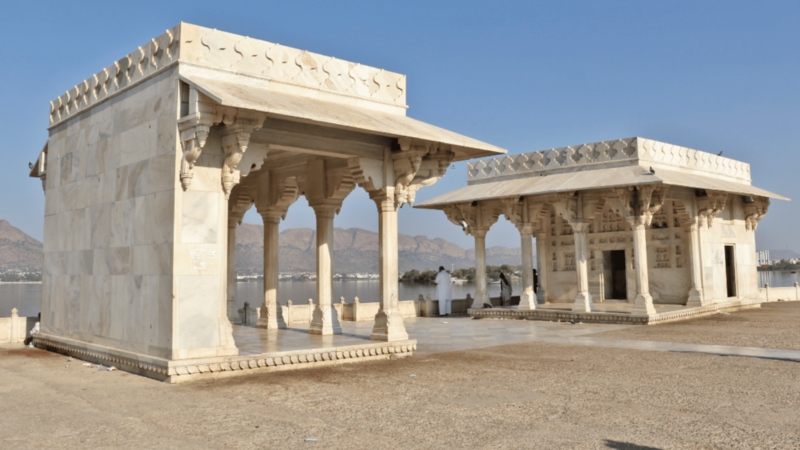
The marble pavilions at Ana Sagar, locally known as Ana Sagar Baradari, are elegant Mughal era structures positioned on the southeastern embankment of the historic Ana Sagar Lake in Ajmer, Rajasthan. Erected as leisure pavilions and pleasure houses, they testify to the architectural synthesis of Mughal aesthetics set within a landscaped lakeside environment. These open marble structures once provided panoramic views of the lake and served as scenic retreats for royal visitors and nobles within the Daulat Bagh garden complex. Rajasthan Tours to India
Historical Background
Constructed by the Mughal emperor Shah Jahan in 1637 C.E., the marble pavilions form part of the enhanced lakeside embellishments commissioned during Mughal rule. Located adjacent to gardens initially laid out by his father, Emperor Jahangir, these structures were integral to the royal landscape of Ana Sagar. During British rule, several of the pavilions were adapted for residential use by colonial officials, and later restoration work returned them to configurations more reflective of their original form. Rajasthan Tours to India
Location and Significance
Situated on the south eastern embankment of Ana Sagar Lake in Ajmer, Rajasthan, the marble pavilion ensemble occupies a significant position within a historic artificial lake landscape. Ana Sagar, originally constructed between 1135 and 1150 C.E. by Arnoraja Chauhan, became a focal point of urban life and royal presence in the region. The pavilions complement this heritage setting, marking interactions between Mughal imperial patronage and local historic environments. Rajasthan Foundation
Architectural Materials and Design
The ensemble includes five white marble pavilions along the lake embankment, along with a hamam, or royal bath. The third pavilion is the largest, built on a design reminiscent of a diwan-e-khas (private audience chamber) found in major Mughal complexes. The open-air design features symmetrical arches supported by carved columns that frame views across the water and gardens. Their reflective white marble surfaces and elegant proportions embody classical Mughal design principles that emphasize harmony with the surrounding landscape.

 4.4•
4.4•
 Ticket needed for all ages
 Entry allowed for all ages
 Kid friendly
 Pets not allowed
 Free water stations
 Washrooms available
 Anjali
 Rohit Kumar
 ANURAG RAJ
 Surbhi Gupta
 Sudhakar Kalwapalli